
Testing a one-second wait for a voice interviewer
Listen to two questions from the same caller booking a flight. When would you start answering?
“Is there a price difference between the two options?” After “options,” a one-second timer makes the caller wait a full second. Now try the same timer on their next question.
“If I were to take the…” Count to three. Only then does the caller say “earliest flight.” A fixed timer long enough to hear which flight they mean would also wait at least three seconds after the price question.
Caller audio from LiveKit EoT Bench Data v1.1, English validation split. Only the quiet lead-in was trimmed. The clips were selected after scoring. The general English group excludes pauses over five seconds. First source recording · Second source recording · CC BY 4.0
When I worked on multilingual voice interviews, a fixed wait cut some people short. These two clips show how that can happen even within one call. How much does an extra half second buy?
Start with a timer
In a replay of 400 English task replies, the timer starts when the speech labels show silence. If the caller resumes before it expires, the timer resets. If it expires in the middle of an answer, that counts as a cutoff. One second cut 36 of 400 replies short. At 1.5 seconds, that fell to 21. LiveKit benchmark recordings
In a separate replay of interviews in Washington, D.C., the extra half second reduced cutoffs from 583 to 318 across 1,475 stretches of speech. An interviewer’s “mm-hm” could split one answer into two stretches. Adjusting the timer to each speaker’s earlier pauses also cut 22 more stretches short than leaving it at its 800 ms starting point. CORAAL word timings, Farrington & Kendall, 2019 · CC BY-NC-SA 4.0
When is half a second enough?
The replay gave Pipecat’s Smart Turn v3.2 the audio available 200 ms into each pause, then allowed 100 ms to score it. On the price question, the score was high enough to close the turn at 300 ms. It gave “If I were to take the…” a low score, but even a two-second maximum wait expired before “earliest flight.” Smart Turn
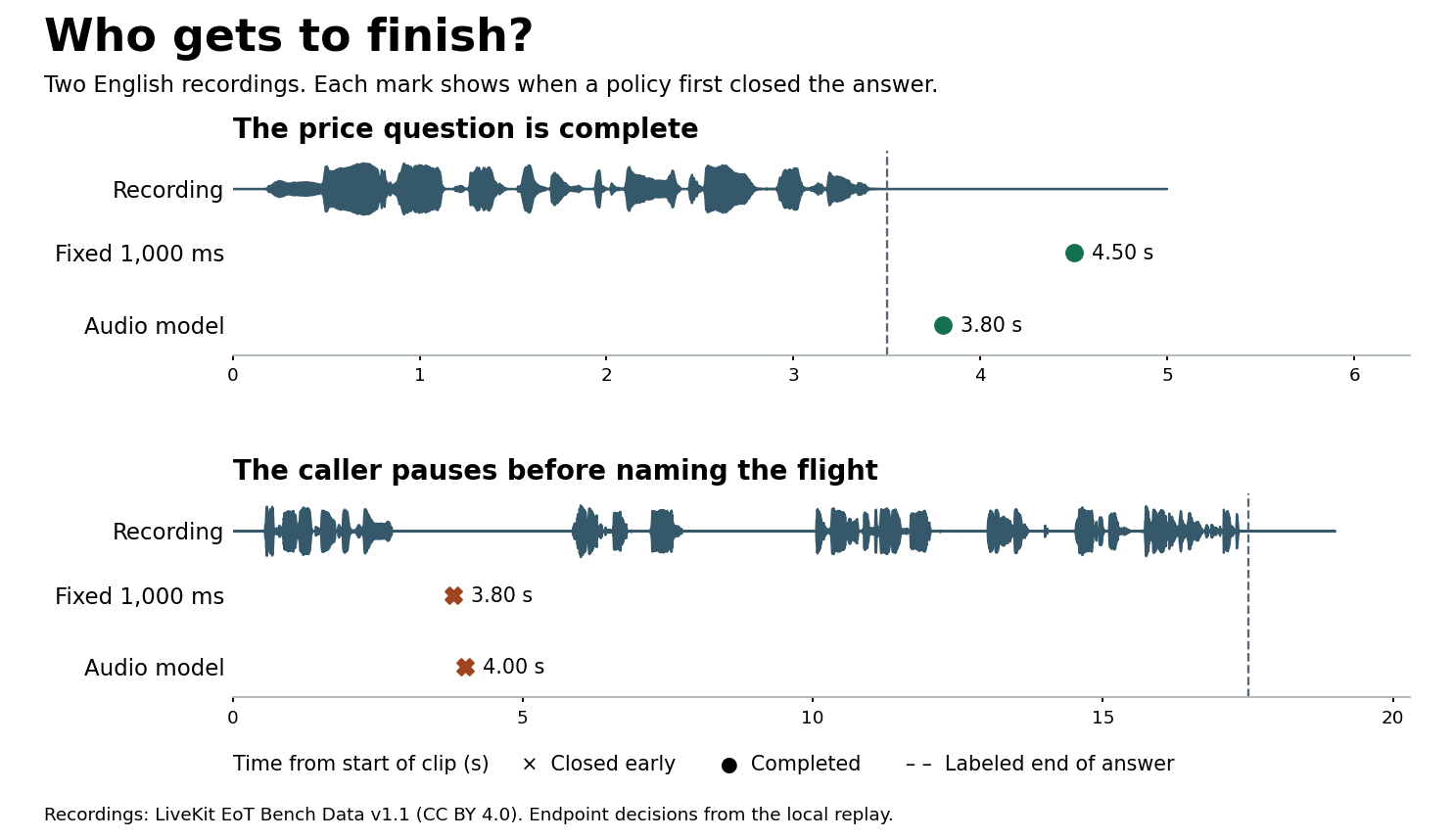
A high score can also be wrong. With a two-second maximum, 53 of the model’s 61 cutoffs on the 400 replies happened at 300 ms. Increasing the maximum wait can’t save a reply the model has already cut short.
The test used an example limit of 7.5% of replies cut short. The fastest settings that met the limit in both tuning groups (640 replies in total) went forward, along with the half-second and one-second minimums chosen for comparison. The table shows what happened on 560 fresh recordings from the benchmark’s accented English group. Each adaptive rule uses the shorter wait when the score exceeds its threshold and the longer wait otherwise.
| Wait | Score for shorter wait | Cutoffs out of 560 | Mean wait | 90th percentile |
|---|---|---|---|---|
| Fixed 1.2 s | — | 38 | 1.21 s | 1.22 s |
| 1.0 or 1.5 s | > 0.75 | 34 | 1.16 s | 1.51 s |
| 0.5 or 1.5 s | > 0.75 | 65 | 0.82 s | 1.51 s |
| 0.5 or 1.5 s | > 0.98 | 35 | 1.33 s | 1.52 s |
Waits are measured on replies each rule let finish, from the last labeled speech to the decision. The caller still has to wait for audio to play.
At the same threshold, lowering the minimum from one second to half a second cut 31 more replies short. Raising the threshold to 0.98 brought cutoffs back down to 35. Only 94 of 525 completed replies then qualified for the short wait. The other 431 took the full 1.5 seconds.
Of the adaptive settings that met the limit during tuning, the fastest used 0.9 or 1.5 seconds. On the new recordings it cut 44 replies short, two over the limit. The fixed 1.2-second timer stayed under it. The model with a one-second minimum cut four fewer replies short than that timer. On the 516 replies both let finish, it decided 49 ms sooner on average but almost 300 ms later at the 90th percentile.
On a real microphone, the speech detector starts the clock. Even with the same one-second timer, WebRTC VAD cut 33 of the original 400 replies short and Silero VAD cut 43. Test with the detector you plan to ship. WebRTC VAD · Silero VAD
Prepare the reply while you wait
After one second of silence, the agent can start drafting a follow-up and keep listening. If the caller resumes, discard the draft. At 1.5 seconds, play it only if the transcript still matches. Advance to the next interview question only then. Pipecat has a gate for holding or discarding a draft. Pipecat’s implementation
The replay counted 420 draft starts for 400 replies, including 20 cancellations. Suppose a usable draft takes 700 ms to produce its first audio. Starting at one second makes that audio ready at 1.7 seconds whether the agent gives the caller one second or 1.5 seconds to finish. The recordings contain only the caller, so actual playback time needs a live test.
Final thoughts
I’d start with a fixed 1.2-second timer on calls like these. On fresh recordings, the tuned fixed timers met all three cutoff targets. The adaptive rules selected for those targets missed each one. In live interviews, measure how often the agent cuts in and how long callers wait to hear the next question.